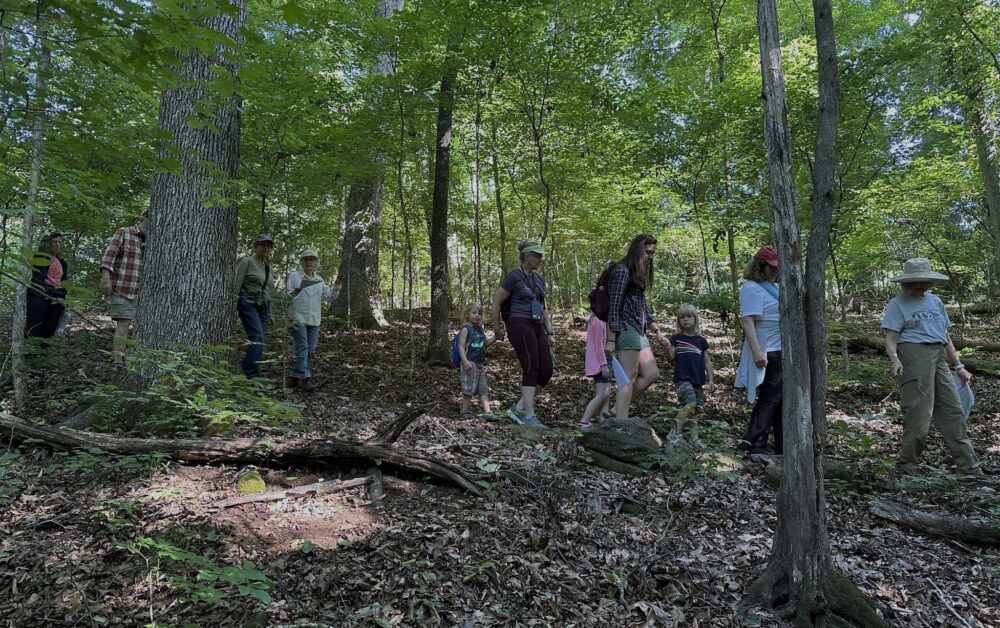
Today’s report was written by Hugh Nourse.
Extra stuff:
Rosemary Woodel has posted videos
of her adventures on YouTube and many people have wondered how to access them.
This link should do the trick: https://www.youtube.com/user/rwoodel1
Here
is the link to Don Hunter’s album with today’s Ramble photos.
Today 23 Ramblers assembled at 8AM at the Arbor
to hear Bob Ambrose recite one of his recent poems on nature, To Remember a
Moment.
Today’s route: was through
the Shade Garden to the White Trail, then across the power line right-of-way to
the Blue Trail. At the end of the Blue
Trail we walked back to the power line right of way on the White Trail along
the Oconee River. From here we took the
White Trail spur back to the Lower Parking Lot.
Shade Garden: Our first
stop was to comment on the huge Japanese maple at the Oleander Plaza. It is the champion Japanese maple in Clarke
County, but one wonders how that was measured because the tree has three
trunks. Do they measure one at breast
height or all of them? Just past the Red Bud Plaza there is a white ash. It is very hard to distinguish from green ash
which is actually the dominant canopy tree in the flood plain. One way is to look at the fruit. The samara of the green ash extends 1/3 to
1/2 way down the body of the fruit, whereas the white ash samara does not. It is terminal to the fruit.
Nearby a black cohosh was in
bloom, so we stopped to talk about its supposed medicinal uses. At one time it was used to treat menopause
symptoms, as well as labor pains in childbirth. Other ailments for which it was
used include rheumatism, arthritis, asthma, and hysteria, and as a gargle for
sore throats. The individual florets
have no petals, only stamens. Bumblebees
release the pollen by sonic vibrations. (See Wildflowers of Tennessee, p. 56.)
Our usual stop at the American
witch hazel revealed galls on the leaves, as well as fruit.
There is a lovely river birch
tree at the turn. It is a wonderful
landscape tree because of the bark texture.
As these trees grow older, however, they lose that wonderful texture, as
we can see along the White Trail by observing the older river birches
there.
The thimbleweed that was
blooming last week had gone to fruit, which was like a thimble and from which
it gets its name. There were unusual,
white, and profuse fungi at the bottom of a tree off the trail. We did not know what it was.
 |
|
| False turkey tail |
White trail: Crossing the road, we found a
mushroom we did know, False turkey tail.
Along this part of the trail we noted that the wild petunia was in
bloom. We have been waiting for the bottlebrush
buckeye to bloom for a long time, at least 4 weeks. It is still not blooming. Blackberries were, however, in bloom, as was
daisy fleabane and Carolina horse nettle.
It had rained earlier, so it was nice to see mushrooms finally making a
show. Right in the path was a Japanese parasol mushroom.
 |
|
| Tumbling flower beetle |
Under the power line
we found many Queen Anne’s lace. Some
had tumbling flower beetles. We also
looked for the dark purple center flower, which one story suggests is blood
from Queen Anne’s finger that spilled on the lace. We did find it on some of the blooms.
 |
|
| Red bud fruit (seed pod) |
As we entered the woods a red
bud tree was fruiting with its bean pods, and a Virginia creeper was twining up
the trunk. On the dead northern red oak there were mustard yellow polypore
mushrooms, and a muscadine grape was twining up the trunk.
 |
|
| Pin lichen |
Blue trail: Walking down the Blue Trail we
spotted an ebony spleenwort. A wonderful
stop was to observe the pin lichen (Cladonia macilenta) on a loblolly
pine, which also had a kind of Green shield lichen. As we walked along a level terrace we noted
the way the land on both sides of the trail was terraced. This is a result of early cotton
farming. In fact this part of the Blue
Trail is a successional forest. It was
one of the last areas farmed. The pines
still dominate the canopy, but the hardwood trees are beginning to take over.
 |
|
| Lanceleaf greenbrier |
On the persimmon tree a poison
ivy vine was growing, as well as the lanceleaf greenbrier. In the fall one can find persimmon fruit
under this tree.
The next stop was for the huge
water oak which has very little growing under it. There are a few pines trying to make it, but
they are not doing well. Under the tree
was another of the land art structures made by Chris Taylor. He uses twigs and
other forest floor debris to form large “bird’s nests”. Behind us was one of
those asian hollies with only four points on the leaves.
We came to the clearing where
Thomas Peters first removed privet. On
the ground at our feet were the basal leaves of elephant’s foot. Because the forest along the Blue Trail is a
transitional forest there were
 |
|
| Script lichen |
a number
of black cherry trees. On one we found a
common script lichen (Graphis scripta).
We also stopped to admire the sawtooth oak which had several vines
climbing up it. One was a trumpet vine
and the other was muscadine.
Ox-eye daisies caught
everybody’s eye as we entered the meadow.
Don reminded us that this is the area to find the frost flowers on a
cold early winter morning. In fact we
saw many wingstems. These were opposite
leaved yellow flowered ones, called Verbesina occidentalis. They were not flowering yet. The frost flowers
actually come from Verbesina virginica, an alternate leaved white
flowered wingstem that comes later.
There is also a yellow flowered alternate
 |
|
| Fleabane (E. annuus) |
leaved wingstem called Verbesina
alternifolia. Daisy fleabanes were
also blooming in the meadow, both Erigeron annuus with thick wide leaves and E. strigosus
with scarce thin narrow leaves. A grass
with a white stripe down its leaf had to be Johnson grass (Sorghum halepense)
because it is too early for silver plume, which has similar leaves. Later, we found another example down on the
white trail in the power line right of way along the Oconee River. This is a bad
exotic grass that “spreads rapidly by seed or by vigorous rhizomes. A single mature plant may produce over 80,000
seeds and 200 feet of rhizomes. The seed
can remain viable in the soil for up to 25 years and begins producing lateral
rhizomes 6-9 weeks after germination.” (see Wildflowers of Tennessee, p. 402)
 |
|
| Large stand of Christmas fern |
As we entered the forest again
we saw a large black cherry with black knot fungus cankers. At the beginning of the slope down to the
floodplain, there was a hog plum tree (Prunus umbellata) that has been marked
with blue tape for study by the Conservation Group at the Garden. The question is why they are not bearing
fruit, although they do flower in the spring.
Going down the slope we marveled at the spread of Christmas fern all
along the slope. The end of the frond
that carried the spores was pointed out to all.
Nearby were rubber cup mushrooms.
We also
 |
|
| Rubber cup mushroom |
noted a deer trail crossing the trail and going down through the
ferns. Farther down the trail before
reaching the flood plain several Jack-in-the-pulpits were in fruit. Avis commented on the five leaves instead of
three, but the guide books do
 |
|
| Jack in the pulpit fruit |
indicate this plant can have three to five
leaves. We also talked about how this
plant can change gender from year to year.
If it gets enough light, nutrients, and water by August, it will become
a female plant the next spring. If it
does not, it will become a male plant next spring, which does not require as
much energy. It was really fun to also
see the leaves of green dragon (Arisaema dracontium) in the same area.
 |
|
| Common anglepod flowers |
Once down on the floodplain we found that the
common anglepod that we saw last year (Matalea gonocarpos) was in flower. It is a milk vine so has milky sap. We should have looked for a white crab spider
that is supposed to make its home on these vines.
As we reached the White Trail there was an old
robust poison ivy on one of the trees.
White trail (river section):The walk along the river on the White Trail was
incredible. We have a list of over 30
species. No wonder this was a long
walk. We started at 8 AM and finished
about 10:30AM. We should not have gone
so long, but since we had started there was only one way to go back, the White
Trail along the river.
Since the list is available below, let me just
mention some of the highlights. One was
our discussion of the stinging nettle (Laportea canadensis). Jennie thought it was the false stinging
nettle, but she found out otherwise. The
false stinging nettle has opposite leaves.
These leaves were alternate. To
cause further confusion there is a stinging nettle with opposite leaves too.
I like to show off the sugarberry tree with its
warty bark. Some want to call it
hackberry. Duncan in his tree book,
actually uses both sugarberry and hackberry for this particular tree.
 |
|
| Beaver chew on Ironwood |
A highlight was a musclewood (AKA Ironwood) tree with fresh
beaver tooth marks and wood chips all around.
Quite a sight.
In the first area in which privet had been
removed several years ago, privet was growing back along with pokeweed and
wingstem, but even worse was princess tree, a very invasive exotic.
Vines were a highlight, too. Bur cucumber, cat greenbrier, roundleaf
greenbrier, saw greenbrier (Smilax bona-nox), muscadine, Virginia creeper,
and yellow passionflower (Passiflora lutea), were all there to be
identified and compared, but none of them
was in bloom.
 |
|||
| Musclewood fruit |
Another comparison was of white mulberry and
red mulberry. Missed by some was the
fruit of a musclewood tree. It was
interesting to compare it to the hophornbeam fruit that we saw earlier near the
power line right-of-way.
 |
|
| Lizard’s tail |
Two more finds were important. One was flowering white avens. We often see leaves of this plant early in
spring, but now it was in flower, but not really very showy. The greatest find of the day was probably the
lizard’s tail in the floodplain area cleared of privet by Thomas Peters. I cannot recall seeing that before, although
it is on the list of plants previously recorded in the Garden’s natural areas.
As usual many of us retired to Donderos for
snacks and conversations. It was a great
ramble, but a little long. Although we
tried walkie talkies to make it easier for everyone to hear what was being
discussed, they were not a complete success.
We are going to have to work more on how to communicate with everyone
better.
Hugh
SUMMARY OF OBSERVED SPECIES:
|
Common Name |
Scientific Name |
|
Shade |
|
|
Japanese maple |
Acer palmatum |
|
White ash |
Fraxinus americana |
|
Black cohosh |
Actea racemosa |
|
American witch hazel |
Hamamelis virginiana |
|
River birch |
Betula nigra |
|
Thimbleweed |
Anemone virginiana |
|
White |
|
|
False turkey tail |
Stereum ostrea |
|
Wild petunia |
Ruellia caroliniensis |
|
Bottlebrush buckeye |
Aesculus parviflora |
|
Blackberry |
Rubus fruticosus |
|
Daisy fleabane |
Erigeron annuus |
|
Daisy fleabane |
Erigeron strigosus |
|
Carolina horsenettle |
Solarum carolinense |
|
Japanese parasol mushroom |
Coprinus plicatilis |
|
Queen Anne’s Lace |
Daucus carota |
|
Damsel bug |
Nabis sp. |
|
Redbud |
Cercis canadensis |
|
Blue |
|
|
Virginia creeper |
Parthenocissus quinquefolia |
|
Red oak |
Quercus rubra |
|
Mustard yellow polypore |
Phellinus gilvus |
|
Muscadine |
Vitis rotundifolia |
|
Ebony spleenwort |
Asplenium platyneuron |
|
Loblolly pine |
Pinus taeda |
|
Pin lichen |
Cladonia sp. |
|
Greenshield lichen |
Flavoparmelia sp. |
|
Poison ivy |
Toxicodendron radicans |
|
Persimmon |
Diospyros virginiana |
|
Lanceleaf greenbrier |
Smilax smallii |
|
Water oak |
Quercus nigra |
|
Chinese holly |
Ilex cornuta |
|
Elephants foot |
Elephantopus tomentosus |
|
Black cherry |
Prunus serotina |
|
Script lichen |
Graphis sp. |
|
Sawtooth oak |
Quercus acutissima |
|
Trumpet vine |
Campsis radicans |
|
Ox-eye daisy |
Leucanthemum vulgare (=Chrysanthemum leucanthemum) |
|
Johnson grass |
Sorghum halepense |
|
Christmas fern |
Polystichum acrostichoides |
|
Rubber cup mushroom |
Galiella rufa |
|
Jack-in-the-pulpit |
Arisaema triphyllum |
|
White |
|
|
Common anglepod |
Gonolobus suberosus (=Matelea gonocarpos) |
|
River cane |
Arundinaria gigantea |
|
Roundleaf greenbrier |
Smilax rotundifolia |
|
Japanese privet |
Ligustrum japonicum |
|
Stinging nettle |
Laportea canadensis |
|
Box elder |
Acer negundo |
|
Oregon grape |
Mahonia aquifolium |
|
Bur cucumber |
Sicyos angulatus |
|
Sugarberry |
Celtis laevigata |
|
North American beaver |
Castor canadensis |
|
American sycamore |
Platanus occidentalis |
|
Resurrection fern |
Pleopeltis polypodioides |
|
Princess tree |
Paulownia tomentosa |
|
Rose of Sharron |
Hibiscus syriacus |
|
Wood ear fungus |
Auricularia sp. |
|
River oats |
Chasmanthium latifolium |
|
Cat greenbrier |
Smilax glaucus |
|
Common elderberry |
Sambucus canadensis |
|
White mulberry |
Morus alba |
|
Pokeweed |
Phytolacca americana |
|
Red mulberry |
Morus rubra |
|
English ivy |
Hedera helix |
|
Great yellow woodsorrel |
Oxalis grandis |
|
Virginia buttonweed |
Dioda virginiana |
|
White avens |
Geum canadense |
|
Lizards tail |
Saururus cernuus |