***
IMPORTANT MESSAGE ***
New
summer schedule for Rambles:
Summer
Rambles will begin at 8:00AM instead of 8:30AM
New
start time is in effect for June, July and August.
In
September we will revert to the 8:30AM start time.
*** END IMPORTANT MESSAGE ***
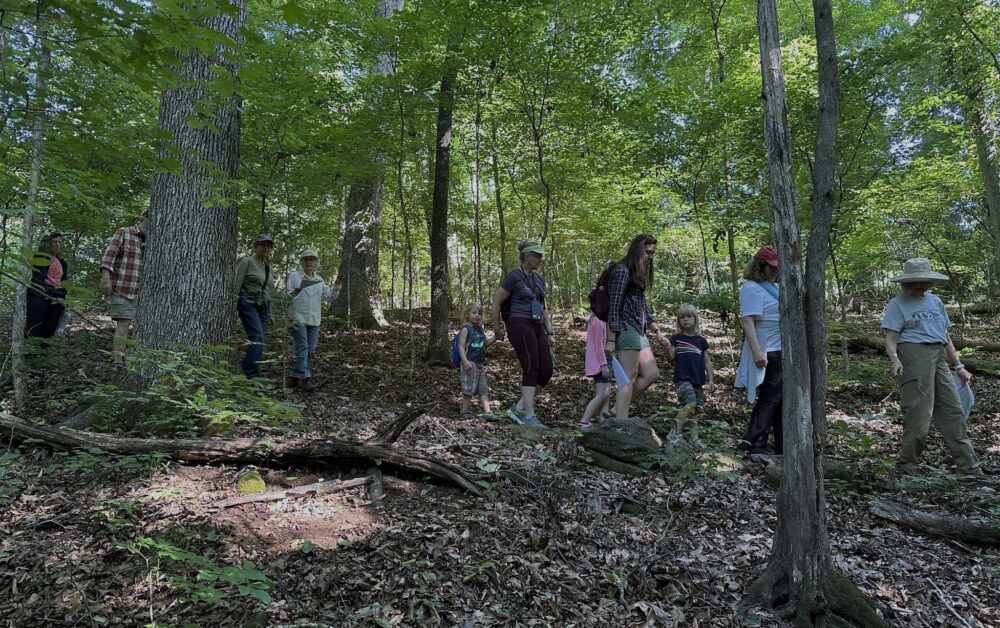
Sixteen ramblers appeared for today’s
walk.
Don Hunter’s photos from today’s ramble
can be found here.
Today’s Ramble Report was written by Hugh
Nourse, with photos by Don Hunter.
We began with a reading by Hugh from The Folklore of North American Wildflowers, by
Timothy Coffee (p. 154):
A
quote from Shin Ying Hu (1976):
According to conventional Chinese
belief ginseng is the crystallization of the essence of the earth in the form
of man. It represents the vital spirit
of the earth that dwells in a root. It
is the manifestation of the spiritual phase of nature in material form. It is further believed that a small portion
of ginseng can cure the sick, strengthen the weak, rejuvenate the aged and
revitalize the dying.” The USDA concluded that the extraordinary medicinal
virtues formerly attributed to ginseng had no other existence than in the
imagination of the Chinese.
Our ramble took us out the White Trail
through the Dunson Native Flora Garden, across the road, up the trail to the
Power Line Right-of-Way. We proceeded
about 2/3 of the way up the road to the fence, turned around and went down the
Power Line Right-of-Way to the service road.
From there we went over to the Dunson Native Flora Garden again, and up
the White Trail to the Arbor the same way we came.
Immediately in the woods we identified
several red maples (Acer rubrum), as
well as a sourwood (Oxydendron arboreum). The black cohosh (Actaea racemosa) we had been observing over several week in bud,
was now blooming. Even one with a broken
stalk was continuing to bloom. At the
road on the way out of the Dunson Garden Hugh pointed out Addison’s
leatherflower (Clematis addisonii),
which had been in bloom on Wednesday,
but was gone today.
The yellow foxglove (a cultivar) was
still blooming on the way to the Powerline Right-of-Way. But the Bottlebrush Buckeye) Aesculus parviflora) was still in bud
the same we have seen it for several weeks.
 |
| Queen Anne’s Lace |
Turning up (to the right) the road under
the Powerline, we found a number of plants.
Queen Anne’s Lace (Daucus
 |
| Queen Anne’s “blood” |
carota),
which as Dale pointed is the plant used to derive the cultivated carrot plant
from which our store bought carrots come from.
A little farther along we found one with a purple flower in the
center. There is a story that the common
name, Queen Anne’s Lace , is reference to a time when a queen sewing lace
pricked her finger. The blood dropped
from her finger on to the lace which is represented by the purple flower.
 |
|
| Wild Petunia |
Another plant here was wild petunia (Ruellia caroliniensis), and across the
road was bitterweed (Helenium amarum).
 |
|
| Deptford Pink |
Sue stated that it soured milk if cow’s ate
it. Terry found a fine leaf that folded
up when touched. It was sensitive brier
(Mimosa microphylla). The spent blooms were seen a little farther
up the road on another plant of the same species. There were quite a few mints
with their square stems, which were probably going to become mountain or white
horse mint (Pycnanthemum incanum). Buried in the grasses we found yellow star
grass (Hypoxis hirsuta), summer bluet (Houstonia longifolia), and Don spotted the Deptford Pink (Dianthus armeria).
We saw a lot of wingstems of which there
are three species: Those with alternate
leaves could be either Verbesina alternaifolia (which will have yellow
flowers), or V. virginica (which will have white flowers). Those with opposite leaves are V.
occidentalis.
We noted the insect damage on the redbud
trees (Cercis canadensis). Dale
talked about the insect that attacked the buds last year and are bare twigs
this year.
 |
|
| White Milkweed |
About the same place but up hill was a
lone white milkweed (Asclepias variegata). The milkweeds are used as larval food by
monarch butterflies, but we have not seen them yet this year.
Sue talked about the Canada thistle (Cirsium arvense), a colonial perennial
that Heather Alley pulled up all over this meadow we were walking through. She missed only a few. Wilf Nicholls, the Director of the Garden, is
Canadian and is currently in Nova Scotia.
When he read the report on what Heather had done, he thought it quite
wrong to call this invasive species Canadian.
There are lots of other and more appropriate names, such as field
thistle or green thistle. The latter
name refers to the green underside of the leaves on this thistle. To pull them out is easy, but one needs
gloves because of all the prickles on the leaves and stem.
Two other plants hiding among the grasses
up the hill were skullcaps and a phlox. The skullcap
 |
|
| Hairy Skullcap |
was hairy skullcap (Scutellaria elliptica). On site I thought it might be hyssop leaf
skullcap, but Don’s photos of the hairs made a clear identification. I should have had my hand lens with me. The phlox is probably thickleaf or Carolina
phlox (Phlox carolina). Once again I
called it Phlox glaberrima, but the
Tennesse book does not have the Carolina Phlox listed, and it is also in our
list of plants in the Garden. Don’s
photo convinced me that it is Phlox
carolina.
Ronnie found an ant cemetery. Dale could not figure out what the other
white things were mixed up with the dead ants.
Walking back down the Powerline
Right-of-Way a group of us were really bowled over by the beauty of an indigo
bunting (Passerina cyanea) that flew
by us. They are such an electric
blue! Next we saw a blue bird (Sialia sialis)
 |
|
| Butterfly weed |
On the ground near the service road we
found a group of butterfly weeds (Asclepias tuberosa). The bright orange was stunning and stood out
dramatically. Once again we talked about
the monarch butterflies that need milkweeds.
 |
|
| Swamp Milkweed |
Crossing the road we entered the bottom
of the Dunson Native Flora Garden. Our
first plant was the highbush blueberry (Vaccinium
corymbosum) covered with unripe green berries. Next was another milkweed, the swamp milkweed
(Asclepias incarnata). A huge elderberry (Sambucus canadensis) was in full bloom, actually almost past. There used to be one on the other side of the
path, but it died and the curators planted this one. The Spanish Bayonets (Yucca filamentosa) gave
Dale an opportunity to discuss the moth that is necessary to pollinate these
flowers. A lot of insects were shaken
out of the flowers: a Leaf-footed bug,
some Yucca moths, and Soldier beetles.
In the adjacent wetland area the lizard
tails (Saururus cernuus) was in full
bloom. Reading from the Tennesse
Wildflower book, p. 45: “This species is also called Water Dragon and
Breastweed, which refers to its use by Native Americans as a root poultice on
infected breasts, wounds, and inflammations.
It has been studied for its chemical and pharmacological properties
; several of its compounds haves a
sedative effect.”
Our next stop was the Silky dogwood or
silky cornel (Cornus amomum). A dispute over spelling was adjudicated by
the sign in front of the plant.
At long last we stopped to see the
ginseng (Panax quinquifolia) which
had a flower bud on it. We discussed the
meaning of Panax. The Tennesse book suggested it meant
cure-all, but Silvio thought it meant all pain which would be cured in the
context it was written. Two more ginseng
plants were around the corner. This
plant is not necessarily a rare plant.
It is not listed in the Guide to the Rare Plants of Georgia, but trading
in this plant requires a permit.
Our last stop was the goldenseal (Hydrastis canadensis), a rare plant in Georgia. Only the red berries were beginning to
show. The curators for the Garden had
put little net bags over the failing flowers to catch the seeds so they might
propagate more.
Then it was on to Donderos’ for our usual
post-ramble fun.
SUMMARY
OF OBSERVED SPECIES
|
Common Name |
Scientific Name |
|
Red maple |
Acer rubrum |
|
Sourwood |
Oxydendron arboreum |
|
White Tailed Deer |
Odocoileus virginianus |
|
Black cohosh |
Actaea racemosa |
|
Bagged trilliums |
Trillium sp. |
|
Leather Flower clematis |
Clematis addisonii |
|
Foxglove |
Digitalis sp. |
|
Bottle brush buckeye |
Aesculus parviflora |
|
Common yellow wood sorrel |
Oxalis stricta |
|
Wild petunia |
Ruellia caroliniana |
|
Queen Anne’s Lace |
Daucus carota |
|
Sensitive brier |
Mimosa nuttallii |
|
Deptford pink |
Dianthus armeria |
|
Daisy fleabane |
Erigeron sp. |
|
Wingstem |
Verbesina occidentalis |
|
Canada Thistle |
Cirsium arvense |
|
Fire ants |
Solenopsis invicta |
|
Hairy skullcap |
Scutellaria elliptica |
|
Yellow Star grass |
Hypoxis hirsuta |
|
White milkweed |
Asclepias variegata |
|
Summer bluet |
Houstonia longifolia |
|
Blue phlox |
Phlox carolina. |
|
Trumpet vine |
Campsis radicans |
|
Butterfly weed |
Asclepias tuberosa |
|
Indigo Bunting |
Passerina cyanea |
|
Eastern Bluebird |
Sialia sialis |
|
Swamp milkweed |
Asclepias incarnata |
|
Elderberry |
Sambucus canadensis |
|
Yucca |
Yucca filamentosa |
|
Silky Dogwood |
Cornus amomum |
|
Ginseng |
Panax quinquefolius |
|
Goldenseal Leaf-footed bug |
Hydrastis canadensis Leptoglossus phyllopus
|