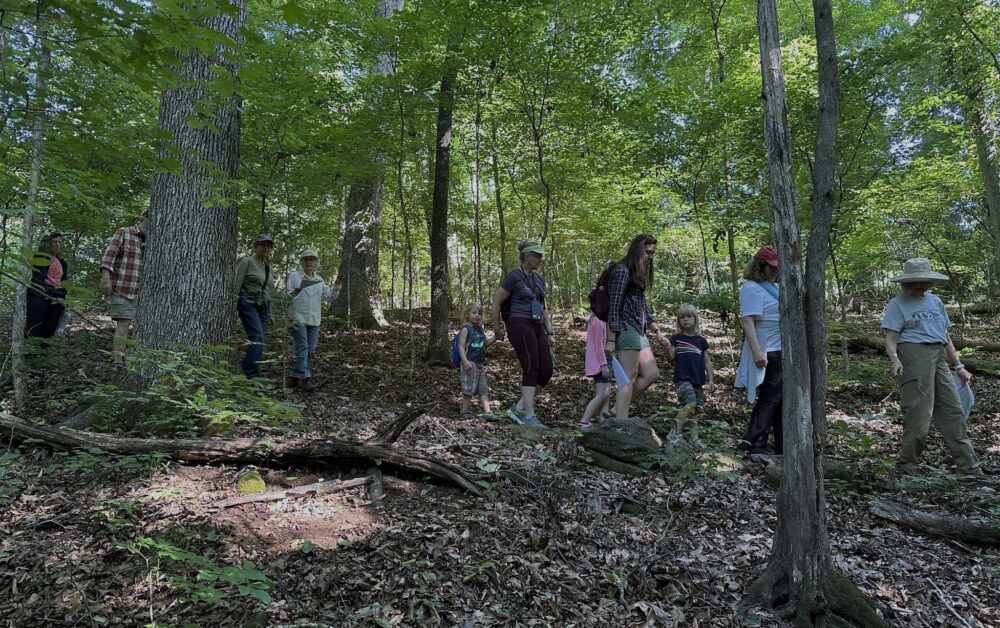
Ramble Report September 8 2016

Today’s Ramble was lead by Dale Hoyt.

Here’s the link to
Don’s Facebook album for today’s Ramble. (All the photos in this post, except
where noted, are compliments of Don.)

Today’s post was written by Dale Hoyt.

No.
Attendees
: 20

Announcements:

Sue called everyone’s attention to an article about Bob and his new
poetry book in last week’s Flagpole (August 31).

Weds., Sept. 14, 7-8:30PM; An Evening of Poetry and Nature @ Russell Special Collections Library. Free
parking at Hull St. Deck next to the Library. An evening of local authors
celebrating poetry and nature hosted by UGA Friends of the Georgia Museum of
Natural History. Reading their poems will be: Philip Lee Williams, Clela Reed, Robert Ambrose, Jr. and retired Ecology professor John
Pickering.

Continue reading

Ramble Report September 1 2016

Today’s Ramble was lead by Dale Hoyt.

Here’s the link to Don’s Facebook album for today’s Ramble. (All
the photos, except where noted, in this post are compliments of Don.)

Today’s post was written by Dale Hoyt.

No.
attendees
:
20

Today’s
reading
:
Dale read an excerpt from an article by Alvaro Jaramillo, Take Note of Taking Notes, that appeared in Bird Watcher’s Digest,
2016, vol. 38(6): 33-37:

Continue reading

Ramble Report August 18 2016

Today’s Ramble was lead by Dale Hoyt.

Here’s the link to
Don’s Facebook album for today’s Ramble. (All the photos in this post are compliments
of Don.)

Today’s post was written by Dale Hoyt.

No.
Attendees
: 22

Today’s reading was
supplied by Rosemary. She intends to ramble in England in the near future, so she
read
a short history of the
British Ramblers Association
, followed by Bill Bryson’s account of the famous
(in Great Britain) Kinder Scout civil disobedience in his book, The Road to Little Dribbling:

Continue reading

Ramble Report August 11 2016

Today’s Ramble was lead by Linda Chafin.

Here’s the link to
Don’s Facebook album for today’s Ramble. (All the photos in this post are compliments
of Don.)

Today’s post was written by Dale Hoyt.

Number of
attendees
: 24

Announcements:


Thank you, Ed and Sue!!

Find the item you’ve been longing for!
Help out the SBGG!

Today’s reading: Linda
read a poem from The Writer’s Almanac: From
a Country Overlooked
, by Tom Hennen:

Continue reading

Ramble Report August 4 2016

Today’s Ramble was lead by Dale Hoyt.

Here’s the link to
Don’s Facebook album for today’s Ramble. (All the photos in this post are compliments
of Don.)

Today’s post was written by Dale Hoyt.

Announcements:

The State Botanical Garden of Georgia has a new weather station that is
internet connected. You can get up-to-the-minute weather at the Garden and a
forecast. Visit the website at: https://athensclarke.weatherstem.com/sbg

When at the above website click on the “Handout” menu item to
discover the many other features available: Twitter, Facebook, automated phone
weather information, etc. It’s a wealth of weather information you can explore!

Our fellow Rambler, Bob Ambrose, has published his new book of poetry: Journey to Embarkation, poems written
mostly before he began writing about nature. Bob says that his book will be
available at Avid Books beginning Friday, August 5. He will also have a few
copies that you can purchase from him at our next Ramble. (The book is also
available online from two sources:
Amazon and Parson’s Porch & Book Publishing
Co
.)

Number of
attendees
: 24

Continue reading

Warm-blooded Bumblebees

Humans and most other mammals are called “warm-blooded,”
meaning that our body temperature arises from heat generated within our bodies.
All our cells are actively engaged in chemical reactions that generate heat. They
are like the engine of a car that runs all the time. Even at idol the engine
consumes gasoline and produces carbon dioxide and heat. Like the automobile
engine we consume fuel (carbohydrates, fats), burn it and use the resulting
energy in several ways: 1)to grow, repair and replace tissues, 2) store energy
(as carbohydrate and fat), 3) keep our body temperature constant (98.6 F°), and
4) move about our environment. The cells of a “cold-blooded” animal
do the same things, but they don’t produce enough energy to raise body
temperature above that of its surroundings. The only way a cold-blooded animal
can raise its temperature is by finding warmer surroundings like basking in the
sun. In fact, an insect sitting in the sunlight may have a higher body
temperature than a human. Because of this it is better to use the terms ectothermic
and endothermic in place of cold-blooded and warm-blooded. (Ectothermic
means heat is obtained from external sources; endothermic meand heat is
generated from internal chemical reactions.)

Bumblebees are partially endothermic. They can generate enough heat to
fly if the temperature of their environment is not too cold. They can
accomplish this feat because of three features: 1) the way their body fluid
circulates, 2) their powerful flight muscles and 3) the way their abdomen is
attached to their thorax.

Let’s begin on a cold morning. The bee contracts all its flight muscles
simultaneously. The muscles that move the wings up are straining against the
muscles that move the wings down, so the wings don’t flap, they just shudder a
little. It’s an isometric exercise – muscle tension without work. It looks like
they might be shivering. The contraction of these opposing muscles generates
heat and the thorax begins to warms up. The hairs that densely cover the bumblebee’s
thorax act as insulation, so some of this heat is retained and warms the body
fluid that bathes the organs in the thorax.

Insects have an “open” circulatory system, meaning that they
lack circulatory vessels like arteries and veins and their tissues are simply
bathed in a fluid (called hemolymph, the insect’s blood) that is slowly
circulated. The circulation of hemolymph is accomplished by a heart, which is a
simple muscular tube that runs from the abdomen through the thorax to the head.
The heart beats with a wave of contractions that push the hemolymph inside the
tube forward toward the head end. (This is like our esophagus works when we
swallow food or water.) The heart keeps pushing hemolymph forward so the hemolymph
in the head end is forced to move back toward the abdomen. So bee blood slowly
flows from the head back through the thorax into the abdomen and then gets
picked up by the heart and pumped forward to the head again. That’s how the
blood gets circulated.

The blood vessel in the thorax runs between the flight muscles and is
warmed by the heat produced when they contract.

Now the way the bee body is built becomes important. The thorax and
abdomen are only narrowly connected, like a wasp waist. (You have to have a bee
in hand to see this – the thorax and abdomen look like they are broadly
connected, but they really aren’t.) The heart must go through this narrow
connection and all the hemolymph in the head and thorax must flow through the
same connection as it moves from the head back to the abdomen. The blood coming
from the head and throax has been warmed by its contact with the contracting
flight muscles. The hemolymph in the heart that is coming from the abdomen is
cooler and it is warmed by the warmer hemolymph moving through the connection
between thorax and abdomen. This heating of incoming hemolymph preserves the
higher temperature in the thorax, and, as the flight muscles continue to
contract, the thoracic temperature rises until the flight temperature is
reached. This mechanism is called a counter current heat exchange and the principle
is used in many mechanical devices, e.g., air conditioners, to improve their
performance.

If a bee starts early in the morning when the temperature is in the low
70s it won’t be able to fly. It must reach a minimum of 86 degrees F before its
flight muscles can operate with the necessary speed of contraction. Once that
temperature is reached it can fly away. (The temperature in the thorax can
reach as high as 104 degrees F or more – the equivalent of a delirious fever
for a human. And bees are supposed to be cold blooded!

Ramble Report July 28 2016

Today’s
Ramble was lead by Linda Chafin and written by Linda with note-taking assistance by Sue Wilde. We are indebted again to Rosemary Woodel for providing the photographs that accompany this post.

Announcements: Bob Ambrose shared the
publication of his new book of poetry, Journey
to Embarkation
, poems written mostly before he began writing about nature.
He read a poem for us,
The Night Music of San Rafael de Guatuso, which was set in Costa
Rica and featured the call of the Dusky Nightjar, a bird closely related to and
sounding much like our own Whip-poor-will. Bob notes that his book is also
available online from two sources:
Amazon and Parson’s Porch & Book
Publishing Co
. (Bob will also have some copies available to Ramblers at a reduced
cost.)

23
people appeared for the Ramble today. 

Today’s route: We wandered
down the Orange Trail Spur to the floodplain, turned right at the base of the
slope, and entered the Powerline Right-of-Way.

Continue reading

Ramble Report July 21 2016

Today’s Ramble was lead by Dale Hoyt.

Except where stated otherwise, all the photos in this post were taken by
Rosemary Woodel. (Don Hunter is still indisposed. We miss you, Don! Please get
well soon.)

Today’s post was written by Dale Hoyt.

Eighteen Ramblers met today, which started out overcast and cool for July. Good for us but not as good for butterflies!

Today’s reading: Rosemary
read a poem by John Moffitt from the collection: Teaching with Fire
, edited
by S. M. Intrator and M. Scribner.

To Look at Any Thing

To
look at any thing,

If you
would know that thing,

You
must look at it long:

To
look at this green and say,

“I
have seen spring in these

Woods,”
will not do – you must

Be the
thing you see:

You
must be the dark snakes of

Stems
and ferny plumes of leaves,

You
must enter in

To the
small silences between

The
leaves,

You
must take your time

And
touch the very peace

They
issue from.

Today’s route: We
went through the formal garden in search of butterflies, pausing whenever we
encountered them. In the Heritage garden we stopped to look at the great
variety of insects on the Sorghum. From there we walked a short way through the
Flower garden and retraced our steps back to the Conservatory.

Red Admiral
butterfly
: The injured tree near the Arbor was still exuding sap and
attracting a variety of insects, including hornets and three Red Admiral
butterflies. Red Admirals are easily recognized by the reddish-orange band on
the upper side of the fore wings and the margin of the hind wings. The
caterpillar feeds on nettles! It is not a rare butterfly here in the Athens
area, but it is not common, either.

Red Admiral; sipping fermented sap

(Forgive the following personal anecdote; feel free to
skip to the next topic.
) This butterfly has a special significance for me. When
I was in kindergarten I contracted rheumatic fever and was confined to bed for
six weeks. The doctor told my mother that under no circumstances was I to exert
myself or leave the bed, so she had to carry me to the bathroom even though she
was pregnant. (In addition to being pregnant my mother was very small woman,
only 4’11” and weighed 95 lbs. Today Rheumatic fever is easily treated by
a round of antibiotics, but at that time bed rest was the only treatment.
Penicillin had been produced was not available to the civilian population
during WWII.) My brother was born in early March and soon thereafter the doctor
decided that I could resume activity. But I discovered that I could no longer
walk – my muscles had atrophied during the month and a half I was bed-ridden and
I had forgotten how to maintain my balance – I could only crawl like a baby.

It was a beautiful March day and my father carried me
outside to join my mother and new baby brother. We were sitting on the steps
enjoying the sun and warmth of early spring when I noticed a butterfly on our
clothes line pole. Like us, it was basking in the warmth of the springtime sun.
I crawled over to the pole to get a closer look at it. It flew off, of course.
I had no idea what it was then, other than a butterfly, but three years later I
saw a picture of a dark butterfly with bright orange bands on its wings – the
caption read: Red Admiral. Every time I see one now I am reminded of the smell
of spring grass and the feeling of awe I felt on that day in March, 1944.

Ecological
consequences of “prettier” flowers

Plant breeders have succeeded
in producing many “improved” varieties of cutting flowers, selecting
for larger and showier blooms. Take Zinnias as an example. The original form of
the zinnia was like a daisy: a disk of tiny florets surrounded by a flat plane
of ray florets. This was the quintessential composite “flower.” The
breeders succeeded in creating plants with pom-pom shaped flower heads. This
transformation was achieved by converting disk florets into ray florets. The
most extremely modified varieties have no disk florets, just a beautiful
hemispherical cluster of ray florets. But a price is paid by this
transformation. In the composite family (Asteraceae or Compositae) the ray
florets with their single, strap-shaped petal (more properly called a ligule)
are usually sterile, lacking both stamens and pistil. Their function is to
attract pollinators, signaling the presence of nectar and pollen that is
produced by the disk florets. So when the outer whorl of disk florets is
converted to ray florets the total number of nectar and pollen yielding florets
is decreased at the expense of doubling the “petals.” The more the
breeders selected for the pom-pom shaped flower the fewer fertile florets
remained. The result was a flower that looked beautiful to the human eye but
that gave no pollen or nectar bounty to the pollinators. A similar process
occurred with the non-composite flowers. Selection for doubling the number of
petals actually converts the stamens into petals. Those wonderful tea roses are
mostly sterile. The moral is simple: if you want to attract butterflies to your
garden you should plant the old fashioned varieties of flowers. By walking
through the Botanical Garden you can see for yourself what plants are most
attractive to the type of insects you want to attract.

Praying mantis.
Someone spotted a cast off exoskeleton of a Praying mantis and another
sharp-eyed observer found a newly molted Chinese mantis nearby. It’s wings were
fully expanded, but the exoskeleton was still soft and unable to afford it
flight. (It takes a period of time for the exoskeleton to harden after each
molt. During that time the insect is almost defenseless and unable to fly until
it stiffens up.

American Dagger Moth caterpillar – best to not touch it

Butterflies

Butterflies are flying pointillist art. The beautiful and
often intricate color patterns on the canvas of their wings is made of millions
of tiny, flat scales, each a single color. The scales are so small that a
square 1/25th of an inch on a side contains hundreds
. To the human eye the
individual scale is like a mote of dust, but when massed together on the planar
surface of the wing they combine to produce the loveliest color patterns in the
living world, each scale a single color. Like human hair and fingernails,
butterfly scales are not living; each is secreted by a single cell that dies
when its work is done. The resulting scale is only weakly attached to the wing
surface and is easily detached. This property is useful in encounters with
spider webs – the scales stick to the silk but break away, allowing the
butterfly or moth to sometimes escape.

Are Butterflies
and Skippers different?
Some lepidopterists treat Skippers a type of
butterfly (like cats are a type of carnivorous mammal). Other regard the
Skippers as a distinct subgroup of the Lepidoptera: Moths, Skippers and
Butterflies. The Skippers don’t care.

How are Skippers
and Butterflies different?
Most Skippers have stout, husky bodies, i.e., their
body is large in relation to the size of their wings. The butterflies have
comparatively large wings for the size of their body. Skipper flight is very
fast and seemingly erratic, from which the common name “skipper” is
derived. The antennae are clubbed, like a butterfly’s , but has a hooked
projection beyond the club. (You need a hand lens to see this in most cases.)

There are several different subgroups of skippers but in
our area we have to deal with just two: the grass skippers and the spread-wing
skippers
.

Grass skippers tend to be smaller and their caterpillars
feed on grasses. When they are visiting flowers their wings are usually held
together over their back, except when basking (more on basking below). 

Spread-wing skippers, as their name implies, hold their
wings horizontally when they are resting or nectaring. But some of the
spread-wings, like the Silver-spotted skipper, just hold their wings in a
slight V-angle that may range from 90 to just a few degrees. 

Fiery skipper; typical basking pose, hind wings almost horizonal; fore wings less open.

Basking grass
skippers
hold their wings in a characteristic pose: both wings are held
open, but the hind wings are held almost horizontally while the forewings are
only slightly opened. The body is oriented so that it is maximally exposed to
the sun. This enables the skipper to gain heat rapidly and keep its body
temperature high enough for rapid flight
.

Fiery skipper
Silver-spotted skipper; note husky body.

There were two common Skippers nectaring in the Flower
garden today: Silver spotted skipper
(Epargyreus clarus), which is a
spread-wing skipper and a Fiery skipper
(Hylephila phyleus), a grass skipper.
The Silver spotted skipper is a large skipper with a prominent silver spot on
the underside of the hind wings and a large orange spot on the underside of the
front wings. The fiery skipper is yellowish-tan with a scattering of black dots
on the underside of both wings. 

Ocola skipper (photo by Don Hunter)
Long-tailed skipper

We saw one individual each of the Ocola skipper (Panoquin ocola),
a Long-tailed skipper (Urbanus proteus) and a Duskywing skipper (Katherine said it
might be Horace’s duskywing (Erynnis
horatius
).

Eastern tiger swallowtail; male – note absence of blue color on the dark border of the hind wings

The Eastern Tiger
swallowtail
is the state butterfly of Georgia. This large yellow butterfly
with black stripes is common and very distinct. The swallowtail in the name
refers to the projections from the hind wings that are reminiscent of the tail
feathers of a swallow. At the base of tails there is a circular marking that,
together with the swallowtail makes this area of the wing resemble a head with
large eye and antennae. Predators may mistakenly attack this pseudo-head and
get a mouthful of wings while the butterfly escapes, a little more ragged but
still alive. At least that is the theory. In support is the frequent occurrence
of damage to this part of the hind wing suggesting that predatory attacks really
are misdirected.

Eastern tiger swallowtail; melanic female
The tiger stripes are still faintly visible.

There is another color form of the Eastern tiger
swallowtail, one that is uniformly dark in color. This results from the
presence of a dark pigment, melanin, the same substance that is produced in
human skin exposed to sunlight. The yellow areas of the wing are black,
obscuring the tiger stripes. (They can still be seen if the wings are back lit
by the sun.) The curious thing is that these melanic forms are only found in
females; the males are always the black and yellow form. In our area about 80%
of the females are melanic. It is thought that the melanic females are mimicking
a distasteful swallowtail, the Pipevine swallowtail, which, like the Monarch
butterfly, acquires a foul taste from its larval food. Support for this idea is
found in the proportion of melanic females: it is highest in the South where
the Pipevine swallowtail is common. In more northern areas, where the Pipevine
is rarer, the melanic tiger swallowtail is less common. And in Canada, where
the Pipevine swallowtail is not found, all the tiger swallowtails are yellow
with black stripes. So it appears that natural selection favors the melanic
form where its model is common. This is thought to be an example of what is
called Batesian mimicry. (A Batesian mimic is harmless and edible but resembles
a poisonous or distasteful species and thereby gains protection from
predators.) 

The puzzle is why the melanic condition is restricted to the
females. Some have suggested that the yellow and black pattern is necessary for
mate recognition by females, but this idea has not been tested, so far as I
know.

You can distinguish tiger swallowtail sexes by the
presence or absence of blue scales on the dark border of the hind wing. If it
is densely blue then it is a female, otherwise it is a male.

Summer Azure butterfly

 Speaking of blue — there was a single Azure butterfly nectaring on some of the flowers, probably a Summer Azure. The Azures are a bit unsettled at present. Some think that there may be at least five different species that differ in their food plants and flight times. Others think that is too many. But all would agree that the blue on the upper surface of the wings is like a piece of the sky.

The surprise for today was a Giant swallowtail, the largest butterfly in North America nectaring in the flower garden. The food plant for this species is citrus. If there are any planted in the garden they may have caterpillars. They also breed on a native plant species, Wafer Ash. I have only seen one of these in the garden, so we’ll have to check it out also.


Giant swallowtail nectaring

Sorghum ecosystem

Sorghum; looks like corn but no ears in the leaf axils;
Flowers are at the top; that’s where the seed appears;
Corn has tassels (male flowers) on top.

In the Heritage garden there is a row of Sorghum plants that are infested with
aphids. Right now the aphid population is relatively small, but aphid
populations can grow rapidly and in a few more weeks every plant will be
covered with them. But you won’t find them on the upper surfaces of the leaves –
you’ll have to lift the leaves to see them. The aphids are sucking the sweet
Sorghum sap and they excrete what they don’t use as a tiny droplet of what is
euphemistically called “honeydew.” This sweet fluid accumulates on
the leaves below the aphid colonies and attracts many kinds of bees and wasps,
who scurry across the leaves searching for the sweet residue.

Small aphid colony on underside of Sorghum leaf

Ladybug larva; these beetle larvae are voracious eaters of aphids
Asian multicolored lady bugs mating;
like their larvae, these beetles also eat aphids.

The attendees at these sugar parties are flies, wasps and
bees. Today the party was dominated by two categories of wasps: social wasps and solitary wasps. The social wasps you’re probably familiar with – yellowjackets,
paper wasps, and hornets. They live in nests made of paper and form large colonies
in which only one individual lays eggs, while the others perform
non-reproductive tasks: foraging, nest construction and cleaning, larval
feeding and colony defense.

Social wasps

Polistes carolina; a paper wasp
Another paper wasp
Another paper wasp, possibly Polistes fuscatus

Solitary wasps were by far the most abundant wasps today
and we were able to recognize many distinct kinds, even though we couldn’t
identify them. 


A scoliid wasp; preys on scarab beetle (like Japanese beetles) larvae

A solitary wasp
Another solitary wasp; pretty orange legs
Yet another solitary wasp
Male honey bee (Drone); big eyes – the better to find a mate with.
(photo by Angeli Menon)
I think this one is a Mud dauber
(photo by Angeli Menon)
Two more wasps
(photo by Angeli Menon)
Solitary wasp and lady beetle (lady bug)
(photo by Angeli Menon)
Looks like a Yellowjacket, but I don’t think it is.
(photo by Angeli Menon)

As the name implies, this type of wasp does not live in
colonies. Each female constructs her own nest, typically a burrow in the soil
or an excavation in a twig. She then searches for food for her offspring and
each kind of wasp seeks a specific type of prey: crickets, spiders,
grasshoppers, caterpillars, etc. Many have very narrow tastes. For example, one
wasp preys only on the queen ants of one species. 

When the prey is found it is
paralyzed, not killed, by the sting and then carried back to the nest where the
female lays a single egg on it and closes the nest. The female wasp then
repeats this process until it dies.

When the egg hatches the wasp larva feeds in darkness on
the still living body of its host until it reaches the size to pupate. The
pupal stage may last until the following year or there may be two or more
generations in a single year. When the adult emerges from the pupa it digs its
way out and starts the next generation.

That’s it for today’s post!

Ramble Report July 14 2016

Today’s Ramble was lead by Linda Chafin.

All the photos in this post are compliments
of Rosemary Woodel.

Today’s post was written by Dale Hoyt.

Eighteen Ramblers met today.

Announcement:

Ed Wilde made the following
announcement:

The “Nature Ramble” has become, for many of us, an important part of
our week and an experience that has changed the way we look at and pass through
the natural world. This remarkable experience is free, but there is a lot of
work that goes into maintaining both the Ramble itself, and the documentation in
the report by Dale, Don, and others.

It seems like it would be a good idea to show our appreciation to the
Botanical Garden, and to the volunteers who diligently give of their time week
after week.

I’m sure there are several ways to show this appreciation, but one way
would be to make sure we all become
members of the Friends of the Garden
, and to either raise the level of our
support, or give an additional donation beyond the cost of a basic membership.
This can be done fairly easily by going online, or contacting the Garden
directly. If you do this, please also
mention that the Ramble is the inspiration for your financial support so that
the Garden recognizes the significance of the efforts of those volunteers

Thank you, Ed!


Today’s reading:

Lee Boyer supplied us with another of his historical
curiosities, an article about Toccoa Falls from The Charleston Courier
published in 1849.

The
Charleston Courier,
(Charleston,
S.C), October 6, 1849, page 2.

THE
FALLS OF TOCCOA.

The
Falls of Toccoa lie on a creek of the same name, about eight miles from Wiley’s
ford, bridge or ferry, in Habersham county, Georgia. This creek is a tributary
of Tugaloo river, which unites with the Seneca, from the S. Carolina side, to
form the Savannah. The meaning of TOCCOA, is “Beautiful,” or
“The Beautiful,” and it is a cascade of such charm and loveliness, as
to be richly entitled to the epithet
. It leaps suddenly, from a rocky precipice, 186 feet perpendicular descent in a sheet of
sparking spray, and swells into bolder beauty, and is even lashed into angry
foam, in seasons of deluge from the chambers of heaven. The view of the Fall,
from the public road, which runs hard by, is very beautiful; and easy pathways,
tending directly to its bring and its basin, bring the spectator into closer
intimacy with its attractions. Near the basin are, or were, two large fragments
of rock, detached and hurled from the precipice, by some shock or convulsion of
nature, or perhaps by the attrition of water, within not very distant memory,
the severances of which has somewhat diminished the original height of the
rocky rampart. The descent of the curved waters, into an unbroken stream of
spray and foam, (occasionally waving to and fro in the wind,) into the mimic
lake below, is exceedingly graceful; and the volume of the fall being generally
small and narrow, and its voice rather the music of a gentle cascade than the
thunder of a roaring cataract, there are usually a quiet beauty and soft charm
about it, which favor reposed more than excitement, and fill the fancy with
dreams of fairies and naiads, than of water-demons or even syrens. When lit up
with moonlight, or when Iris arches, with brilliant dies and dolphin hues, in
the silver spray, the scene partakes still more of fairy enchantment
. The valley of the
fall, too, is lovely and romantic, and creatively suggestive of slyphs and
dryads.

The
sudden and abrupt plunge of the waters over the rock, without any previous
warning, or “note of preparation,” has probably
given rise to a
legend or tradition, which may be converted to poetic use. An Indian Chief is
said to have become enamoured of a faithless maiden of another and hostile
tribe, who pretended such a full return of his love, as to have impressed him
with the delusive belief that she would betray her own tribe into his power.
She accordingly arranged her plot; and, one dark night, affecting to pilot her
confiding lover and his followers to the surprise of their enemy’s camp, she
treacherously led them over the precipice, to their utter destruction and the
extinction of their tribe.

Today’s
route
: From the arbor we took the mulched White trail down to the Orange connector
trail; turning left on the connector we arrived at the Orange trail by the
river. We followed the Orange trail downstream, turned left and walked a short
distance to the first spur that lead into the beaver marsh. Then we returned
back to the Orange trail and retraced our steps to the Purple trail which we
took back to the Conservatory/Visitors Center and Donderos’ Kitchen.

Birds

Among the regular ramblers are some who know their birds.
Today Page, Tom, Sarah, and Linda were able to identify these birds by voice
alone: Broad-winged
hawk, Red-tailed hawk, Hooded warbler, Carolina wren, Acadian flycatcher and
Pileated woodpecker

Insects and other Arthropods

European Hornet sipping fermented sap

A White oak at the back edge of the Arbor appeared to have been injured
and was seeping sap which, because of the hot and humid weather, was starting
to ferment. The odor attracted a number of insects, among them Yellow jacket
wasps and a large European hornet. Also seen was a Red Admiral butterfly and a
number of tiny flying insects too small to be identified.Sometimes an insect will imbibe so much fermented sap that it becomes drunk and unable to fly. We share a lot with insects. After a couple of beers I’m unable to fly.

Beetle antenna three times as large as the ant carrying it.

As we left the Arbor Emily noticed a large Carpenter ant carrying an
unusual object in its mouth. Jeff thought it was an antenna from a large
beetle. We can’t be certain, but both of us think the beetle was a type of
Longhorn beetle, family Cerambycidae, genus Prionus,
that has similar antennae.

Lynx spider

While photographing some of the plants Rosemary noticed a small Lynx
spider. This type of spider does not construct a web to capture its prey. It
hangs out on flowers and vegetation and simply grabs any suitably sized insect
and paralyzes it with a quick bite.

Praying mantis nymph on the back of someone’s hand

Fall webworm nest; the black dots are caterpillar frass.

We found several nests of the Fall webworm on a single tree. This colony
of caterpillars  caterpillar is the  Fall webworm is often confused with the
Eastern Tent caterpillar (ETC). The ETC emerges in the early spring at the same
time the leaves of its host plant, Black Cherry, emerge. The silken nest is
built in the crotch of the tree and the caterpillars move out of the nest each
day to feed on leaves. In contrast, the Fall webworm emerges much later, in
mid- or late summer and encloses the leaves on the ends of branches in a silken
web. To some extent the caterpillars are protected from predators by the web as
they feed on the leaves. They progressively expand the nest to enclose fresh
leaves. In my neighborhood I frequently see Fall webworm nests in the leaves of
Pecans and Hickories, but many other kinds of trees are recorded as host plants.
To some extent the silken nest prevents predators from eating the caterpillars,
but over 50 species of parasitic flies and wasps have been recorded as
attacking the caterpillars. I’ve seen paper wasps search in vain to find an
opening in the nest. The nests are unsightly but the caterpillars do little
harm to the tree, eating leaves from just a few branches. You will get more
pleasure out of watching the caterpillars feed and develop than if you remove
the nests.

A rolled leaf formerly containing a caterpillar

Another insect was not seen, but sign of its presence was obvious. A leaf
was suspiciously rolled into a cylinder and when opened contained a small
amount of frass (a polite term for caterpillar poop). No sign of the
caterpillar, though. Leaf rolling is a common strategy that many insects and
spiders adopt. It provides a shelter from rain and some protection from
predators. I don’t know how the caterpillar accomplishes the task of rolling up
a leaf though. The layers are anchored with silk and it would be interesting to
watch the process in action.

Female Katydid; the curved structure at the end of her abdomen is the ovipositor;
 the three white objects in front of the ovipositor are eggs she extruded.

In the beaver marsh Emily caught a female Katydid that was in the act of
laying eggs. The photo shows a scimitar-shaped structure at the end of the
Katydid’s abdomen. This is an ovipositor – an egg laying device. She uses it to
cut a slit in the stem of a plant and then deposits an egg in the slit. You can
see several eggs at the base of the ovipositor.

Ecological Grass
types

Grasses are divided into two general groups: cool season and warm season
grasses. The cool-season grasses actively grow during winter, early spring or
fall, becoming dormant in the summer; warm-season grasses are just the reverse.
So grasses that flowered earlier this year are cool-season and will be setting
seed right now. Examples of cool-season grasses we saw today are: Foxtail, Wild
Rye Grass, River oats, Johnson grass, Rice cut grass and River cane.

Linda is raising cane

River cane

There are two species of native bamboos in our area: River cane and
Switch cane. River cane (Arundinaria
gigantea
) is tall, reaching 10 feet or more in height while Switch cane (A. tecta) is much shorter – only 4 to 6
feet high. These native canes are little peculiar in that they don’t produce
seed every year. In fact, they only flower after growing 70 years, plus or
minus. Furthermore, the entire population of cane flowers at the same time and
then dies. During the years that cane is not flowering it is spreading
vegetatively via rhizomes, so the large stands that in early colonial times
covered the southern river bottoms may have been composed of only a few genetic
types. (Vegetative reproduction produces clones of genetically identical
plants.) This may explain, in part, their synchronous reproduction. The cane
was used by Native Americans in many ways: making musical instruments, baskets,
arrows and wattle-and-daub shelters.

Jimson weed

Jimson weed

Jimson weed is not native to the US, it was brought to America by the English,
probably as a medicinal plant, and it first grew wild in the area around
Jamestown. (“Jimson” is a corruption of Jamestown.) It is a member of
the Nightshade family which are notorious for being poisonous and so are all parts
of Jimson weed. It is also, at lower doses, hallucinogenic. One of the
substances derived from this plant, scopolamine, is often featured in WWII
movies where it is referred to as “truth serum” and administered to
captured allied soldiers by their Nazi interrogators.

Muscadine grape leaves

Muscadine
grapes

One of the many pleasures I receive from these rambles is when I am
confronted with something that ought to have been obvious but that I had never
thought about. One of the more abundant plants on forest floor in most of the SBGG
is the Muscadine grape. In some areas it almost seems to be the only plant in
the herbaceous layer. Year after year these small plants never seem to increase
in size and I should have been aware of the obvious question: Why aren’t these
grape vines climbing trees? In many places in the SBGG there are large
Muscadine vines growing up and hanging from trees, but I’ve never noticed any
young vines climbing a tree. The solution to this puzzle is that grape vines
can only grow up trees that are adjacent to them. All those little grape plants
scattered over the forest floor and distant from trees are waiting for a tree seed
to germinate next to them so they can literally grow up with it. Those large grape
vines you sometimes see dangling from a tree are just as old as the tree is –
they started out life together.

I’ve noticed another thing about these little grape plants on the forest
floor. They don’t show any signs of being eaten. And there are plenty of deer
around to eat them, yet they seem immune. Do they taste bad? I googled “Do
deer eat muscadine grape leaves” and found a lot of hits from sites that
talked about deer eating grapes (the fruit), but few mentioned the leaves, let
alone Muscadine leaves. One site suggested that Muscadine leaves didn’t taste
as good as ordinary grape leaves, but offered no evidence. Most websites were
concerned with keeping deer out of their vinyards, chiefly to prevent loss of
the wine-making fruits. They only mentioned that the deer would eat leaves in
passing. I’m left feeling that the question is unanswered.

Succession
on former cotton fields

Much of Clarke County was in cotton cultivation, if not continuously, at
least at one time or another. The legacy of this era are our red clay
“soils” that are really the mineral soil underlayment – all that is
left after the top soil with its nutrients has been lost by years of erosion
and crops that were “heavy feeders.” One of the things Linda remarked
on was the absence of plants with showy flowers growing dry shaded woods. Could
their absence be due to the impact of cotton agriculture? Or is it due to the
presence of deer? Deer were hunted nearly to extinction in the southeastern
states in the 19th century. There was a program of reintroduction to Georgia
from 1928 to 1979, some deer coming from populations as far away as Wisconsin.
But the last 37 years have seen tremendous growth in the deer population and
they could be an important factor affecting the herbaceous layer in our
forests. Earlier this year I toured Walt Cook’s property and was amazed at the
number of seedling and sapling oaks and hickories I saw. I asked Walt if there
were many deer on his property and he replied, “No.” The difference
between Walt’s property and the SBGG was very dramatic.

Tipularia flower stalk with unopened flower buds

Cranefly
orchid (Tipularia)

Linda told us that last winter she had seen the leaves of the Cranefly
orchid in this area of the Garden and wanted us to look for the flowering
stalks that should be appearing right now. She had failed to find any
previously. Almost immediately Ed and Tim located some. The buds had not opened
yet, so we will need to monitor this area carefully. Tipularia flowers are very
small and colored brown and gray, just like the leaves on the forest floor, so
they are difficult to find, blending as they do with the background.

Northern Red
Oak snag

White Avens fruits; note the hooked bristles
White Avens flower

White Avens

White Avens is a plant we see almost year round, but we never seem to be
present when it is flowering. At last, today we got to see both the flowers and
the fruits. The plant in winter has a basal rosette that is composed of simple
leaves. As the season progresses the new leaves emerge and are compound,
looking almost like a different plant. Each of the seeds is surrounded by
scales that bear hooked bristles to catch on the fur or socks of passing
animals.

False nettle leaf
False nettle inflorescence with buds

False nettle

This plant resembles Wood nettle which is also found in the Garden. To
distinguish them look at how the leaves are arranged. In False nettle the
leaves are opposite; in Wood nettle the leaves are alternate. Wood nettle also
has many hairs on its stems and leaves. Each hair contains the substance that
stings if you brush against them.

Johnson
grass

Johnson grass; the broad white mid-vein is characteristic, but not unique.

American Elm

American Elm leaf; note the oblique leaf base

Misc. Photos

Climbing Milkweed seed pod
Lurid sedge fruits
Elderberry fruit
Green Ash seeds on the path
Poison hemlock; the plant that killed Socrates
Wingstem flowers


Summary of
Observed Species

Common
Name

Scientific
Name

European hornet

Vespa
crabro

Yellow jacket

Vespula
sp.

Red Admiral

Vanessa
atalanta

Foxtail grass

Setaria sp.

Jimson weed

Datura
stramonium

Poke weed

Phytolacca
americana

Muscadine grape

Muscadinia
rotundifolia

Northern Red Oak

Quercus
rubra

Cross vine

Bignonia
capreolata

White avens

Geum
canadense

Wild Rye grass

Elymus glabriflorus

Hammock Spider-lilly

Hymenocalis
occidentalis

False nettle

Boehmeria
cylindrica

Ebony spleenwort

Asplenium
platyneuron

Blood root

Sanguineria
canadensis

Lemon Balm

Melissa
officinalis

Acadian flycatcher

Empidonax
virescens

Praying mantis

Mantodea

Fall webworm

Arctinae:
Hyphantria cunea

Dwarf St. Johnswort

Hypericum
mutilum

Climbing Milk weed

Gonolobus
suberosus

Red spotted purple

Limenitis
arthemis

Beefsteak plant

Perilla
frutescens

Jewelweed

Impatiens
capensis

Johnson grass

Sorghum
halepense

Wingstem

Verbesina
alternafolia

Green ash

Fraxinus
pensyllvanica

Box Elder

Acer
negundo

Elderberry

Sambucus
canadensis

Flat scale sedge

Cyperus sp.

American Elm

Ulmus
americanus

River oats

Chasmanthium
latifolium

Leafy elephant’s foot

Elephantopus
carolinianus

Bur cucumber

Sicyos
angulatus

Common Day Flower

Commelina
communis?

River cane

Arundinaria
tecta or gigantea

Sensitive fern

Onoclea
sensibilis

Carolina wren

Thryothorus
ludovicianus

Heal all

Prunella
vulgaris

Hooded warbler

Setophaga
citrina

Red-tailed hawk

Buteo
jamaicensis

Poison hemlock

Conium
maculatum

Rice cut grass

Leersia
oryzoides

Katydid

Orthoptera:Tettigoniidae

Duck potato

Sagittaria
arifolia

Lurid sedge

Carex
lurida

Broad-winged hawk

Buteo
platypterus